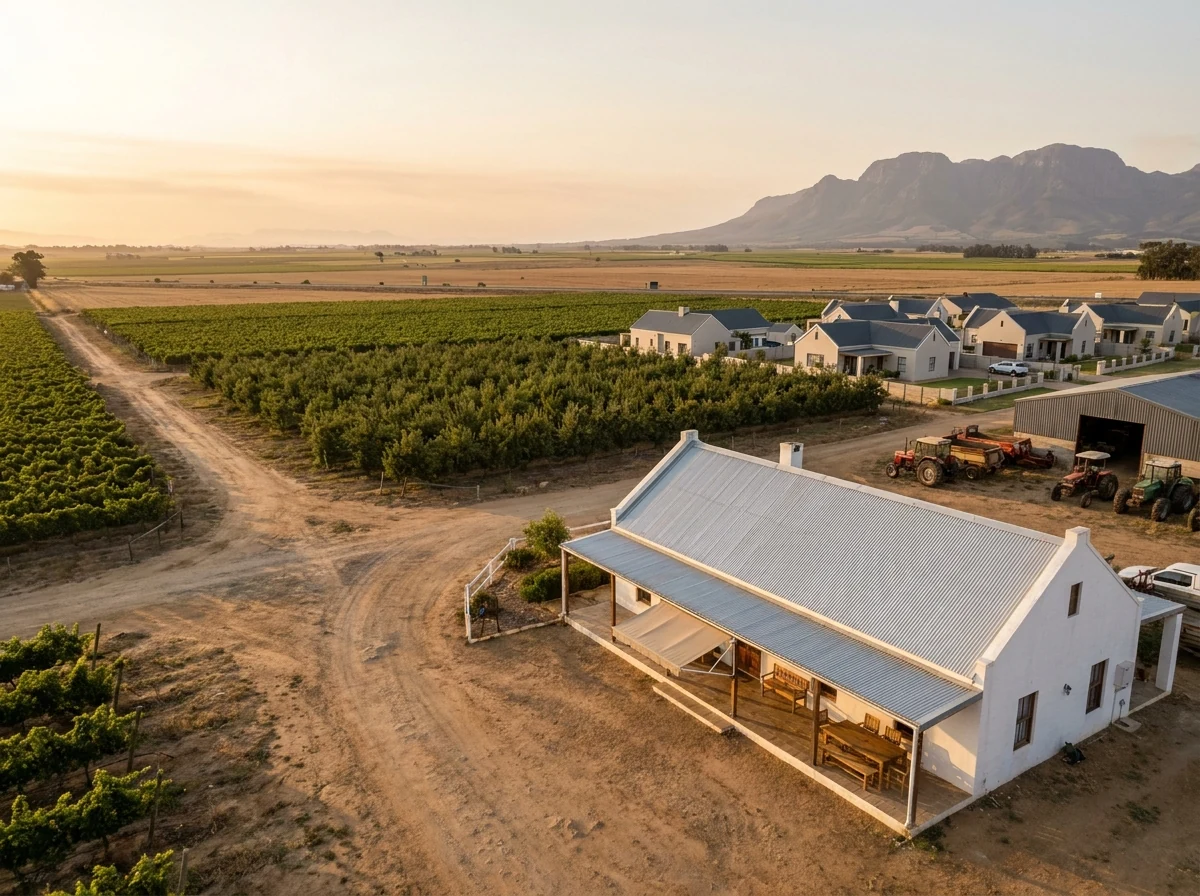
Two Building Stocks, One Road Apart
Klapmuts sits at a genuine crossroads, in more ways than one — established farm homesteads with their own stoeps and outbuildings on one side, newer estate-style family homes with clean modern glazing on the other. A farmhouse window and a new-build sliding door ask for different answers, and we spec each on its own merits rather than defaulting to whichever product is easiest to sell.
What We Fit Most Often Here
- Roller blinds for new-build family homes with wide, modern glazing.
- Folding-arm awnings over an established farmstead's stoep.
- Zip screens enclosing a new-build patio or braai area without permanent walls.
Reading The Afternoon At The Gateway
The valley's sun arithmetic is set out in full in our field guide, and it applies here as much as anywhere on the R45: the midsummer sun stands just under eighty degrees at noon, midwinter noon sits at about thirty-three, and the point on the horizon where the sun sets swings through nearly sixty degrees between the solstices. That last figure is the one that decides a Klapmuts window. A stoep roof or an eave already intercepts most of the midday summer sun; nothing intercepts a ray arriving almost horizontally at the end of the day.
What varies here is how much skyline is left to hide behind. On the valley floor further up, a ridge can take the sun away early and abruptly. At the crossroads the ground opens out, so we do not assume either way — the consultant stands in the room and works out where your own shade line falls before recommending a fabric. Two houses on the same farm road can have genuinely different afternoons, which is why nothing is specified off a map.
The Farmhouse Reveal And The New-Build Slider
An established homestead window is usually deep-set in a thick, lime-washed wall. That depth is an advantage: an inside-mount blind sits flush in the reveal with no bulk and nothing pooling on the sill, and it avoids fixing into a gable-end facade that would rather be left alone. A timber venetian suits those rooms particularly well, because tilting the slats steers the light instead of simply removing it — a study keeps the view down the rows while the midday glare comes off the desk.
The newer estate homes on the other side of the road ask the opposite question. Wide, modern glazing wants a single clean drop, which is where a roller blind earns its place, and a very wide opening is either split or handled as a linked pair rather than asking one drop to do the whole span. Which of those it is depends on the actual measured width, so it is decided at the visit rather than promised in advance.
Stoep, Braai Room And The Honest Limits
Outdoors, the two products that come up most in Klapmuts are a folding-arm awning over the stoep and zip screens around a braai area. The awning shades on demand and retracts to let the low winter sun back in, which matters here, because that winter sun is warmth worth keeping rather than a problem to solve. Zip screens hold their mesh in a zipped channel so it cannot flap, which is what makes them workable on an evening when air drains off the ranges onto an open stoep. Both get a motorised wind sensor as standard, sized for occasional gusts rather than a daily coastal rhythm.
Two limits we would rather state now than at the quote. An interior blind works on the inside of the glass, so it solves glare immediately and heat only partly — if a room is genuinely uncomfortable late on a summer afternoon, the honest answer is a product that stops the sun outside the pane. And our roller shutters are a shading product rather than a security-rated one; if security shuttering is what you are actually after, say so and we will point you at the right conversation instead of selling you the wrong thing.