In brief
- A venetian steers the direction of light: tilt up for glare-free daylight across a desk, tilt down for privacy, close flat for dark.
- Timber venetians use 50mm basswood slats, suited to sash and casement windows set deep into thick lime-washed walls.
- Aluminium venetians have powder-coated, moisture-proof slats in 25mm or 50mm for kitchens, sculleries and wet rooms.
- Very wide windows may need splitting or extra ladder-tape support, which is sized at the free measure in Groot Drakenstein.
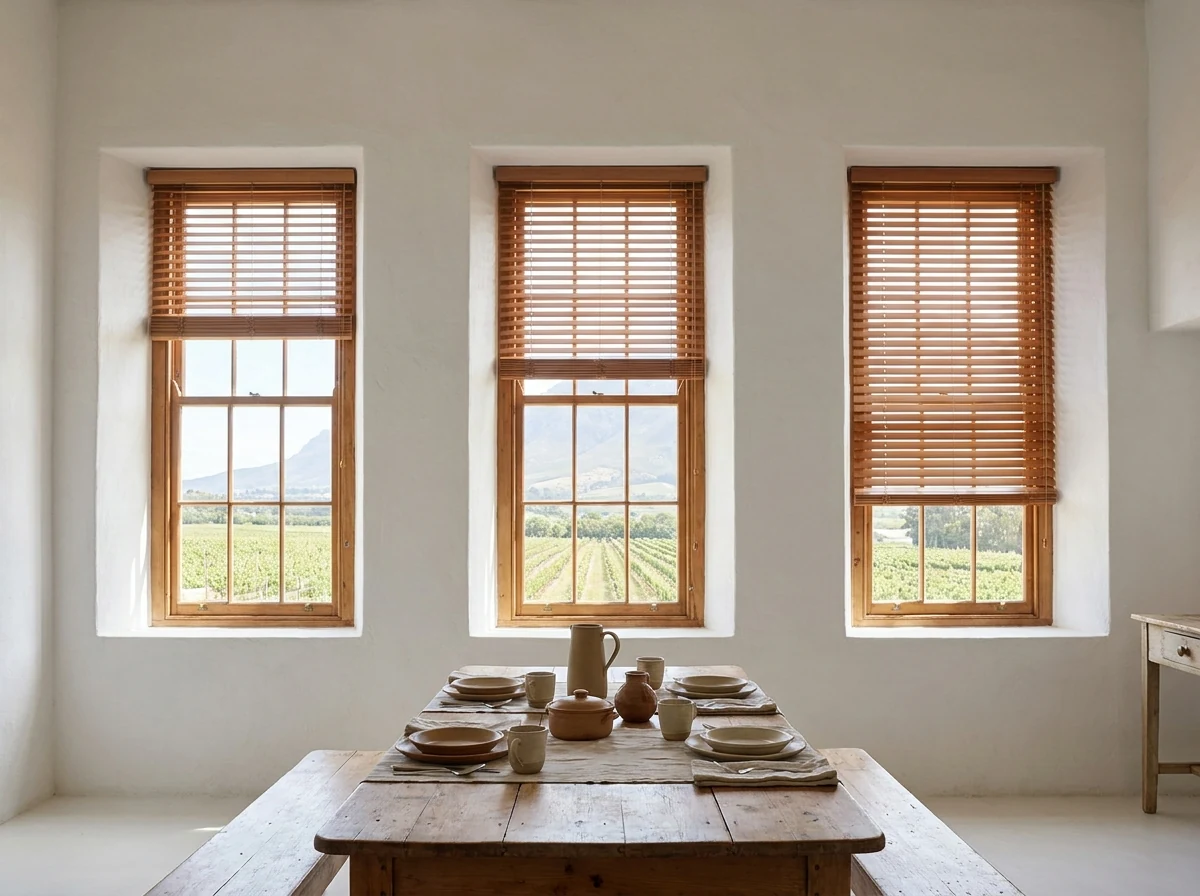
Adjustable In A Way A Roller Isn't
A roller is open or closed by degree; a venetian steers light's actual direction — tilt up for glare-free daylight across a desk, tilt down for privacy from a neighbouring double-storey window, close flat for full dark. On a homestead with hour-by-hour sun swings across a long stoep-facing wall, that control matters more than it does in a simple box room.
Timber Venetians
Warm, architectural, and the natural choice for a study, a dining room with a long farm table, or any deep-set window where timber trim and timber slats belong together. Keep them out of high-steam rooms — quality lacquer handles normal humidity but not a steam-heavy scullery.
Aluminium Venetians
Crisp 25mm or bolder 50mm slats, powder-coated and moisture-proof — the right call for kitchens, sculleries and any wet room where fabric or timber eventually fails. A huge colour range, including wood-look finishes, keeps the look consistent with timber venetians elsewhere in the same home.
Fitted Across The Valley
Timber venetians are a particular favourite on the heritage-style sash windows around Franschhoek, while aluminium suits newer kitchens near Klapmuts just as well as an older farmhouse scullery near Simondium or a family home around Paarl.
The essentials
| Best for | Studies, dining rooms and long stoep-facing walls where the sun moves hourly |
|---|---|
| Light control | Slats tilt to redirect light without closing off the view |
| Privacy | Tilt down against a neighbouring double-storey window; close flat at night |
| Moisture | Aluminium for wet rooms; timber for dry rooms only |
| Operation | Manual tilt and lift; motorised tilt on premium lines |
| Care | Dry dusting for timber; damp wipe for aluminium |
Venetian blinds: common questions
Timber or aluminium venetian blinds: which suits a Groot Drakenstein farmhouse kitchen?
Aluminium. Its powder-coated slats are moisture-proof, so cooking steam and a wet cloth do them no harm. Timber slats are lacquered and cope with normal household humidity, but a steam-heavy kitchen or scullery will eventually defeat the finish. If the dining room next door has timber venetians, a wood-look aluminium finish keeps the two rooms looking like one scheme without putting real timber over the sink.
Why pick a venetian over a roller for a long wall facing the stoep?
Because the sun on that wall changes hour by hour, and a venetian can follow it. A roller can only come down further as the glare builds, and the view goes with it. Slats tilted up send daylight onto the ceiling and take the glare off a desk or a farm table, while the vineyard rows stay visible between them. On a homestead with a long stoep-facing wall that adjustability is used every day.
Are timber venetian blinds too heavy for a wide homestead window?
Not if the blind is planned properly. Width is the thing to watch: a very wide timber blind is heavy to lift and the slats can sag between supports, so wide windows are either split into two blinds or given extra ladder-tape support. Old sash and casement windows often divide naturally at a mullion, which makes the split look intended. The consultant sizes this at the measure against the actual opening.
Works well with
- Roller blinds: A blockout roller suits the bedroom under a metal roof that must go properly dark, with venetians in the living rooms of the same house.
- Folding-arm awnings: An awning takes the worst of the afternoon sun off the stoep-facing wall, and the venetians behind it fine-tune what is left.