In brief
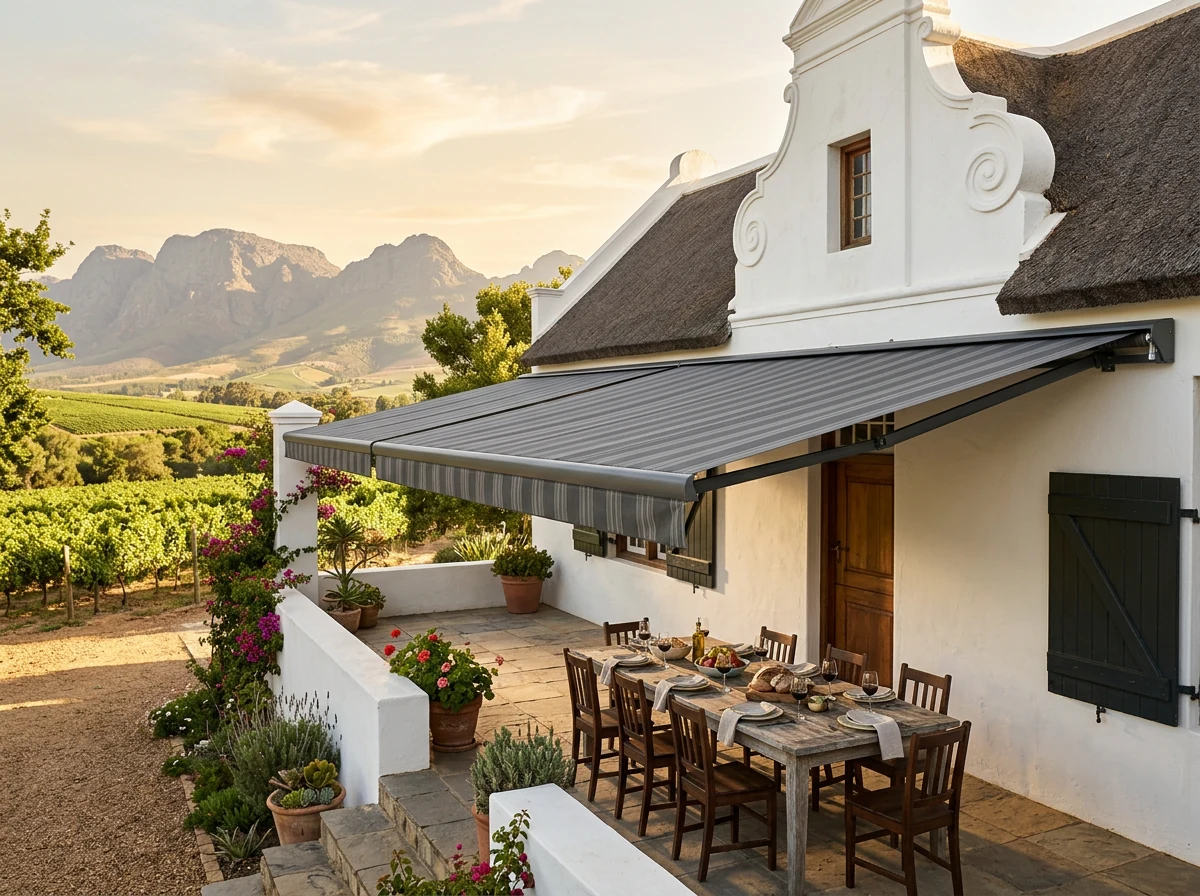
- A folding-arm awning shades a werf-facing stoep through the low late-afternoon summer sun and retracts for winter, when that same low sun is welcome on the paving.
- Every awning fitted in Groot Drakenstein is motorised with a wind sensor as standard, so it pulls itself in before evening air off the ranges catches it open.
- Projection runs to roughly 3-4m over wide spans, in solution-dyed acrylic fabric that holds its colour under Cape summer UV.
- It is a shade product and not a rain product: fine at a pitch for light drizzle, never for standing water.
The Seasonal Argument A Fixed Roof Can't Make
A werf-facing stoep bakes in the low, late-afternoon summer sun for months at a time — exactly the elevation a fixed roof would shade all year, including the mild winter afternoons when that same low sun is genuinely welcome. A folding-arm awning solves both: extended in summer, retracted through winter, on the same bracket.
Full Cassette Or Open Mounting
A full cassette seals the fabric and arms away when retracted — the right call for a weather-exposed werf elevation. Semi-cassette or open mounting works well on a more sheltered stoep. Projection runs to roughly 3–4m over wide spans, in solution-dyed acrylic fabric that holds its colour under Cape summer UV.
Honest Limits
An awning is a shade product, not a rain product — fine at a pitch for light drizzle, never for standing water. The fixing substrate matters too: brick, timber and steel farmstead walls all take a bracket differently, which is exactly what your free measure is for.
Fitted Across The Valley
We fit folding-arm awnings on stoeps throughout Groot Drakenstein and out to smallholdings near Simondium, newer patios around Klapmuts, courtyards in Franschhoek and homes near Paarl.
The essentials
| Best for | An open stoep that wants summer shade on demand and winter sun back |
|---|---|
| Wind or weather | Motor and wind sensor as standard; light drizzle at a pitch only |
| Operation | Motorised, or a crank handle on a sheltered stoep |
| Mounting | Full cassette on exposed werf walls; semi-cassette or open where sheltered |
| Fabric | Solution-dyed acrylic that keeps its colour in summer UV |
| Extras | LED lighting and a vertical drop-valance on premium lines |
Folding-arm awnings: common questions
Can a folding-arm awning stay out overnight on a Groot Drakenstein stoep?
It should not. Most days in this valley are mild, but on any evening the Groot Drakenstein and Klein Drakenstein ranges can send air down onto an open stoep, and fabric left out is what gets caught. The wind sensor fitted as standard retracts the awning by itself when that happens. Treat the sensor as a backstop and make a habit of folding the awning away when you leave the table.
Should I choose a full cassette or open mounting for a farm stoep awning?
A full cassette closes the fabric and the arms away when the awning is retracted, and it is the right call on a weather-exposed werf side that takes rain and dust through the year. Semi-cassette or open mounting works well on a more sheltered stoep, tucked under a roof line. The consultant decides this by standing at the wall and looking at what it is exposed to, which is why it is settled at the free measure.
Will an awning bracket hold on an old brick or timber farmstead wall?
Brick, timber and steel walls each take a bracket differently, so the fixing is assessed on site before anything is promised. Age matters as well as material. On a building older than sixty years an awning cassette counts as a change to part of a structure, and that needs a permit from Heritage Western Cape first. We bring the drawings, profiles and product data for that conversation; we do not submit on your behalf.
Works well with
- Zip screens: The awning shades an open stoep in summer; zip screens close in the braai room beside it for windy evenings and winter.
- Roller blinds: The awning stops the afternoon sun before the glass, and a sunscreen roller inside deals with glare once the canopy is folded away.